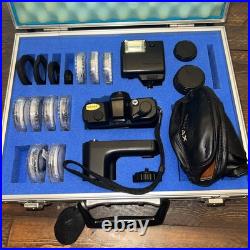


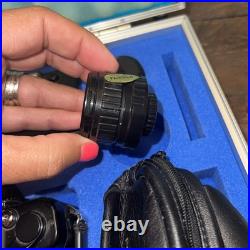
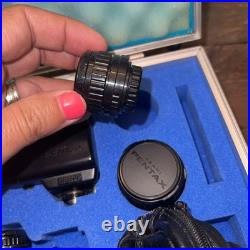


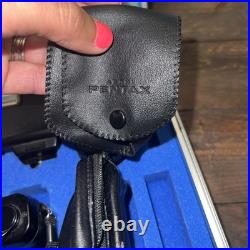
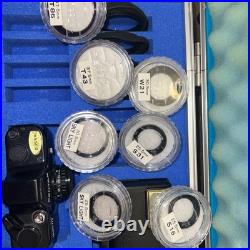


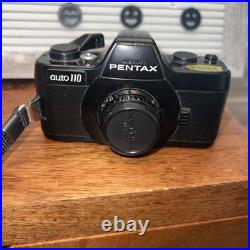
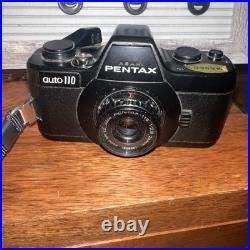
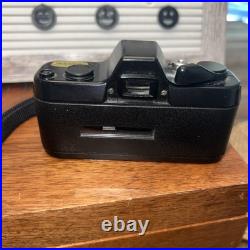

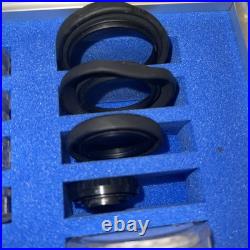
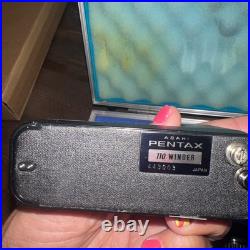
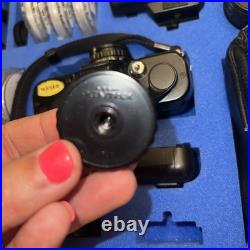
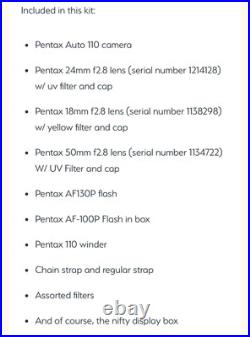

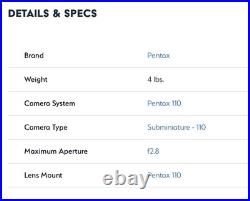
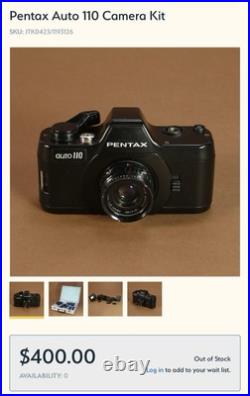



Arguably one of the niftiest SLR cameras ever made, the Pentax Auto 110 and its successor the Auto 110 Super, were introduced by Pentax for the 110 film format, popular in the 1970s and 80s. These cameras were produced from 1978 until 1985, featuring interchangeable lenses, fully automatic exposure control, TTL metering (center weighted), and true SLR viewing... All the while, fitting easily in the palm of your hand. At its introduction, the Pentax Auto 110 system featured three lenses: an 18mm f/2.8 wide angle, a 24mm f/2.8 standard, and a 50mm f/2.8 telephoto. In 1981, three more lenses were added to the lineup, including the 18mm f/2.8 "pan focus" wide angle, the 70mm f/2.8 telephoto, and a 20-40mm f/2.8 zoom lens. A number of other accessories were also made for the Auto 110, both by Pentax, as well as other companies, including teleconverters, close-up filters, and the like. All the lenses in the Auto 110 system have a maximum aperture of f/2.8, due to the aperture diaphragm being located in the body of the camera and combined with the camera's shutter. The Auto 110 Super was introduced in 1981 and offered some improvements over the earlier Auto 110. The Super has an electronic self-timer, a brighter viewfinder, shutter lock, single-stroke film advance, and it also introduced a new power winder with a better battery door - the door on the original winder is notorious for breaking. The camera requires two LR/SR44/V76 batteries to power both the light meter and the shutter.